Showing posts with label UX. Show all posts
May 22, 2017
Aug 19, 2016
Jetlag Apple Watch App

I found myself traveling from India, to China, to USA in a matter of a week. I ended up Terribly Jetlagged. So I created Jetlag.
Jetlag maps your sleep with Apple's Sleep API (Yet to be released) and creates notifications on when to take a nap based on sleep habits and artificial intelligence. This reduces fatigue and enables a smoother recovery.
Jetlag uses predictive learning to map one's circadian rhythm, enabling "Predictive Naps". Predictive naps are presented to the user as a push notification, "Take Nap" or "Dismiss". Tapping "Take Nap" creates a pre-set timer to resync one's body to their natural cycle.
This will also require Apple to open up their faces API
Tags:
apple watch,
concepts,
Personal Work,
Product Development,
prototyping,
ramblings,
typography,
UI,
UX
Jan 15, 2016
Augmented Reality Interface for Military, Search and Rescue, and Space Applications
Soldiers, police, firefighters, astronauts, search and rescue workers all face the problem of managing information. This is an attempt to organize radios, comm links, encryption, health and power in an arm-mounted interface. The following is a design sketch for maps:
The first iteration would be a flexible e-ink display to be strapped to the wrist. Large touch points make it easy to use in the field with gloves or wet hands. As Augmented reality quickly develops, the interface moves from the wrist to virtual reality within AR sunglasses:

The interface is designed to adapt as technology quickly advances....
Nov 5, 2015
The Verge reviews the stone
My favorite project yet:
I worked with a talented EE, leading the design and manufacture of 800 prototype units.
Reviewed by The Verge:
May 23, 2015
Project Ara and the IoT
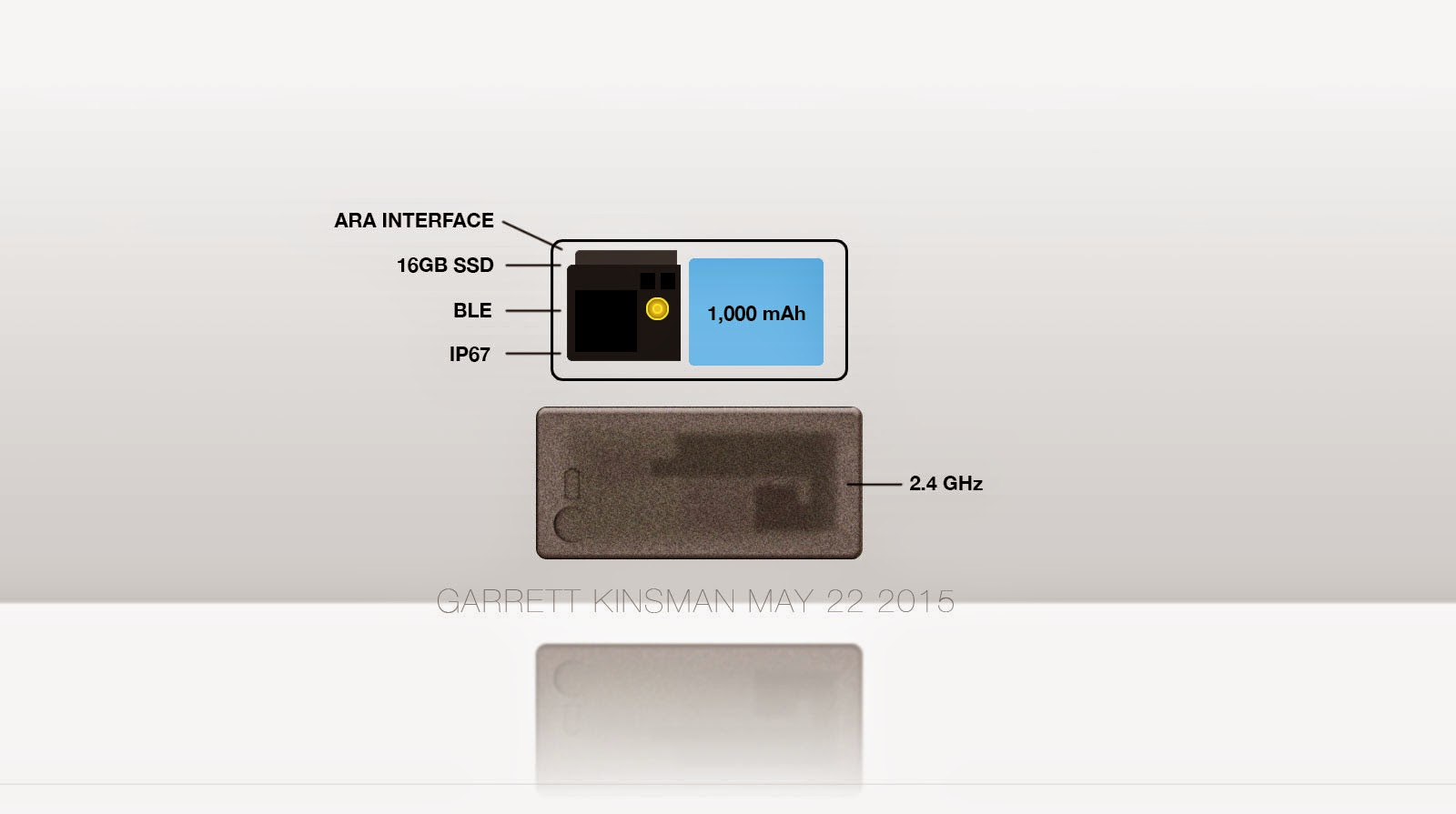
Ara will come with BLE built into the base model gray phone. I am interested in what this looks like 3 years down the road as technology advances and miniaturizes. Here's what it might look like:
This opens up a world of possibilities, as a module can now operate on its own. In a world of perfect modularity each module will have its own power supply (this concept was laid out at the first DevCon). Betavoltaic batteries would be awesome, but those are hard to find... As chipsets become more efficient, we can begin running radios on very very tiny amounts of energy, thus powering the IoT.
The module above is possible with current technology, but swap out the main BLE chip and things really get interesting. A Wi-Fi powered chipset, though it requires more power, can move much more data. We will soon see LTE chipsets that can mesh, completely changing the economic structure of the internet.
After many months of thought on the matter, I have come to realize that almost everything we see and touch will soon have a networking computer inside. A new kind of network is forming all around us, right now its BLE and bits of Wi-Fi. We have to think about how we can leverage a network like this not only to connect our washing machines, but build a free, open internet than anyone access.
The democratization of the internet begins not with subsidized internet connections, but with devices we can fit in our pockets.
And the technology is only going to get better...
*Note this post represents purely personal opinion and does not reflect the views, pursuits or opinions of any affiliated organization or company.
Sep 26, 2014
Thermal Camouflage in Fashion and War
I am fascinated by the cycle of war and technology. Almost every major technological advancement of this century came from defense research. Nuclear power, electronic computers, radar and microwaves... The list goes on and on. Many of these eventually make it onto the consumer markets, the intersection of many of these advancements allow a smartphone to exist today.
By looking into current defense technologies (and areas of interest), we can predict what will end up on the consumer markets in years to come.
Me C.2011
One technology we will see hit the mainstream markets in 2015 is thermal imaging (the ability to see heat). FLIR (who makes insane thermal cameras for the US military) already has a fairly expensive case-camera for the iphone. The Seek thermal camera has released another iPhone camera. Project Ara (Google's modular smartphone) plans to include a small thermal camera module in their smartphone. A man from FLIR showed me a prototype unit for Ara smaller than 1cm³.
Thermals cameras are here, but what is not in the consumer market are ways to become almost invisible from them. Invisibility has fascinated mankind for centuries, and humanity is just beginning to make it work. The only glimpse of defense research is this 2011 image by BAE:
But what if the same could be done with something as small and comfortable as a jacket? This is a prototype fabric material inspired by wearable circuit technology I saw at a Wearables Meetup here in San Francisco:
Instead of an LED panel, there wold be tiny Peltier thermoelectric modules at the center of each hexagon. The technology I saw used conductive thread sewn into the fabric. This would be CNC sewed on a layer beneath the waterproof layer above. The small coolers would look something like this:
These coolers would be attached to a hexagonal, flexible, heat conductive material that would be sewn into place beneath waterproof fabric. Hundreds of these would be sewn into place and controlled by onboard batteries, cameras, and a micro computer. A person would wear this comfortably as a jacket. When not acting as camouflage it could keep the wearer in perfect comfort, even charging the battery from body heat (Utilizing the Seebeck effect). Electronic garments will hit mainstream fashion, though it will take perhaps another 8 years. This is all feasible today, although very expensive.
When observed from afar, the jacket would read the surrounding heat image with tiny thermal cameras, then render that onto the jacket as a pattern of hot and cool tiles. The wearer's heat signature would be masked by the jacket, rendering them invisible from a thermal camera. Maintaining comfort wold be difficult in this arrangement as the tiles dump heat from the surface of the jacket into the wearer's body. I have yet to imagine a heat dump system.
It is only a matter of time before advanced technology meets mainstream fashion (it has already started). It will likely all happen here in San Francisco.
Aug 30, 2014
An Android L touchpad
A touchpad concept for interaction with the Android operating system. The future of the mobile OS will be a system that can display on your smartphone, TV, laptop, or projector- all through one, main input. This input device could also act as a secondary battery charger. While I prefer a mouse or \Wacom, this design would complement a chromebook quite nicely and is great for web browsing. Created in Photoshop
Aug 10, 2014
A Protective Bumper Case For Project Ara
I generally frown upon putting a case around a phone. A smartphone should inherently be designed to be indestructible. In 2011, Casio released a line of military-spec phones that I x-rayed in an earlier post. It was truly liberating knowing my old device could photograph under water, bounce off cement, even be thrown into fires, and never break. This device, built almost 5 years ago is still booting up smoothly: It's speakers are also louder than most...
But today, as devices become outdated more quickly, most manufacturers invest in computing, cameras, and screens. Companies neglect basic durability and waterproofing. An iPhone is a good example: poor development iPhone 5c didn't last me three weeks!
When Project Ara releases this fall, keeping the device safe will be important. This concept I created utilizes a plastic shock absorbent bumper. This is wrapped around the phone to keep modules in place, and dirt and dust out. It features a unique design to allow access to Ara's buttons hidden beneath the case. Prototype image:
As we learn more about inputs, such as charging and headphone jacks, the form of the case will accommodate. Fully waterproofing the device could be achieved through custom, 3D printed cases. If ARA is truly going to connect the next 3 billion, It will have to survive in all climate conditions. I want a device that I can take swimming, hiking, travel the world with. Maybe even hand down to my future children. The way current products are built, that will rarely ever happen. I'm here to change that.
**Further Sketching:
Aug 9, 2014
TEDx Talk: Connecting Through New Interactions In Music
Something that had been on my bucket-list for quite some time:
Jul 13, 2014
Canon Ara Portable Imaging System Camera Module
A visual and 3D study into the industrial and advertising design of the Canon brand. I'm a huge fan of canon and hope they build an Ara camera module. Logo and image used without permission, for presentation purposes only. I want one! Note: I also tried to incorporate the fallacies of Canon ad techniques, like not showing the whole product.
Jun 29, 2014
Project Ara Work
In order for Project Ara to work, the endoskeleton (the part that connects all the pieces) must be made inexpensively. The current prototype is made out a three sandwiched pieces of aluminum, with data wires running in between. I propose an even simpler model, where the components molded into a high strength plastic. Glass-filled nylon would work great. This Ara incorporates a Geiger counter to measure radiation levels.
The geiger counter block will use this model tube coming in at 34mm long: GMT-06

UPDATE 8/22/2014: I recently got in touch with a gentleman working on an actual radiation module called DO-RA. He explained to me that using a silicon based sensor is much more accurate and power efficient. I look forward to testing it!
Jun 12, 2014
Satellite Android Handset
I like to ponder the future of Android and the devices that run it. Google just announced it will be launching several hundred satellites to bring internet to the furthest reaches of earth. It will need a device to receive and transmit to the satellites. It will also need a way to distribute that once on the ground. Being quite unhappy with the durability and capability of modern handsets, I designed a better one:
Created in SolidWorks and Photoshop.
Apr 18, 2014
Ara and OpenMod Wireless
Just returned home from Google's Project Ara Developer's Conference in Mountain View CA. I joined forces to help start OpenMod Wireless, a solutions company poised at providing Industrial Design, Electrical Engineering, Supply Chain, and Branding for companies looking to incorporate their technology into the Ara ecosystem. (Ara a modular smartphone where each part is interchangeable that will be released Q1 of 2015). My Job was to create these concepts to attract attention:
I really want to make translucent modules that glow:
These were all done with SolidWorks and Photoshop. It was also my job to create the branding and logo for OpenMod. It had to look great on a wide variety of products as we are interested in making all types of modules for Ara. Apr 3, 2014
An Experement in Notifications with Bio-Connected Devices
I recently acquired a Pebble Smartwatch, and decided to do a little experiment. A watch has always represented being synced with the human race. Android just announced an update to allow Android to run on a watch. They will even have 500mb of RAM! The less powerful Pebble forwards notifications to one's wrist, buzzing. It truly is an innovative product. Now the whole internet, the vast majority of the human race, will be instantly assessable on one's wrist. The psychological effects will be substantial! As a designer this is what I focus on...
I've worn a watch all my life, and almost never take it off. I think it's a statement, perhaps about the un-trustworthiness of mobile devices. Casio even makes some cool solar powered watches that have a compass and moon phases! But Pebble is different, it tethers via Bluetooth to my phone. Being waterproof and having 3 days of battery, I can wear it constantly. But after a week I found it rather annoying.
There is a stressful reaction that is created when being constantly connected to everyone, all the time. The ability to disconnect is extremely important for the human psyche. Today the interfaces for managing notifications from a myriad of devices hasn't been very developed. Everyone reacts differently, that's why the system for managing notifications in our digital ecosystems is extremely important.
What notifications we get will be heavily dependent on what we're doing and how we're feeling. Bio-connected devices in our digital ecosytems will have to manage this very carefully so a negative stress response isn't induced. I have a lot of faith that this will come in time, likely with Artificial Intelligence.
For now, I will stick to my Analogue Luminox dive watch, or my Casio Solar Mudman. Technology and humans must maintain a balance, and for now, I prefer to disconnect!
There is a stressful reaction that is created when being constantly connected to everyone, all the time. The ability to disconnect is extremely important for the human psyche. Today the interfaces for managing notifications from a myriad of devices hasn't been very developed. Everyone reacts differently, that's why the system for managing notifications in our digital ecosystems is extremely important.
What notifications we get will be heavily dependent on what we're doing and how we're feeling. Bio-connected devices in our digital ecosytems will have to manage this very carefully so a negative stress response isn't induced. I have a lot of faith that this will come in time, likely with Artificial Intelligence.
For now, I will stick to my Analogue Luminox dive watch, or my Casio Solar Mudman. Technology and humans must maintain a balance, and for now, I prefer to disconnect!
Ambitorch
A year ago while camping in Florida, I wanted a better flashlight for reading and drawing. The problem with modern flashlights (and headlamps) is they have a concentrated beam. They are too bright and end up blinding. I wanted an ambient solution that spread light evenly over a large area. I created Ambitorch:
This uses three AAA batteries with a Ultra Fast-strobing Lumilux LED to produce a warm glow. It is an attempt to reproduce the light of a lantern, my favorite reading light. A prototype is in the works, a production model would likely use two (more available) AA batteries. Thanks to my sister Mere for modeling. Done in Solidworks, Photoshop, and Shot with my archaic Canon 10D.
Mar 2, 2014
Jan 30, 2014
Work Featured in South African "Tech" Magazine
The editors at South African "Tech" magazine requested to use my designs on project Ara! They used what I thought was my worst image though. I'm still enthralled nonetheless.
Jan 28, 2014
An Approach to a Smartcwatch
This is based on my earlier attempt at a smart watch, now re-designed in CAD. A smart-watch needs to 1. Look cool, and 2. Be customizable. Most of the smart watches out there don't do any of those things. This would also have a really cool UI that I'm currently sketching. Done in SolidWorks, screen designed in Photoshop.
Jan 23, 2014
The X1. A Curved Smartphone.
Jan 20, 2014
Audiate Case Study
Audiate has been a project of mine for about a year now, in some form or another. We are building the best android music player, then want to allow groups to interact with music together. I recently spent a week in Kansas City at the Homes For hackers, working on the idea with developers. Auston Leroy, a software guru, joined the team. We decided to head back to New York as developers are much more plentiful around around the local colleges. Kansas City Public Television wrote a great article up on us during our stay.
Subscribe to:
Posts (Atom)